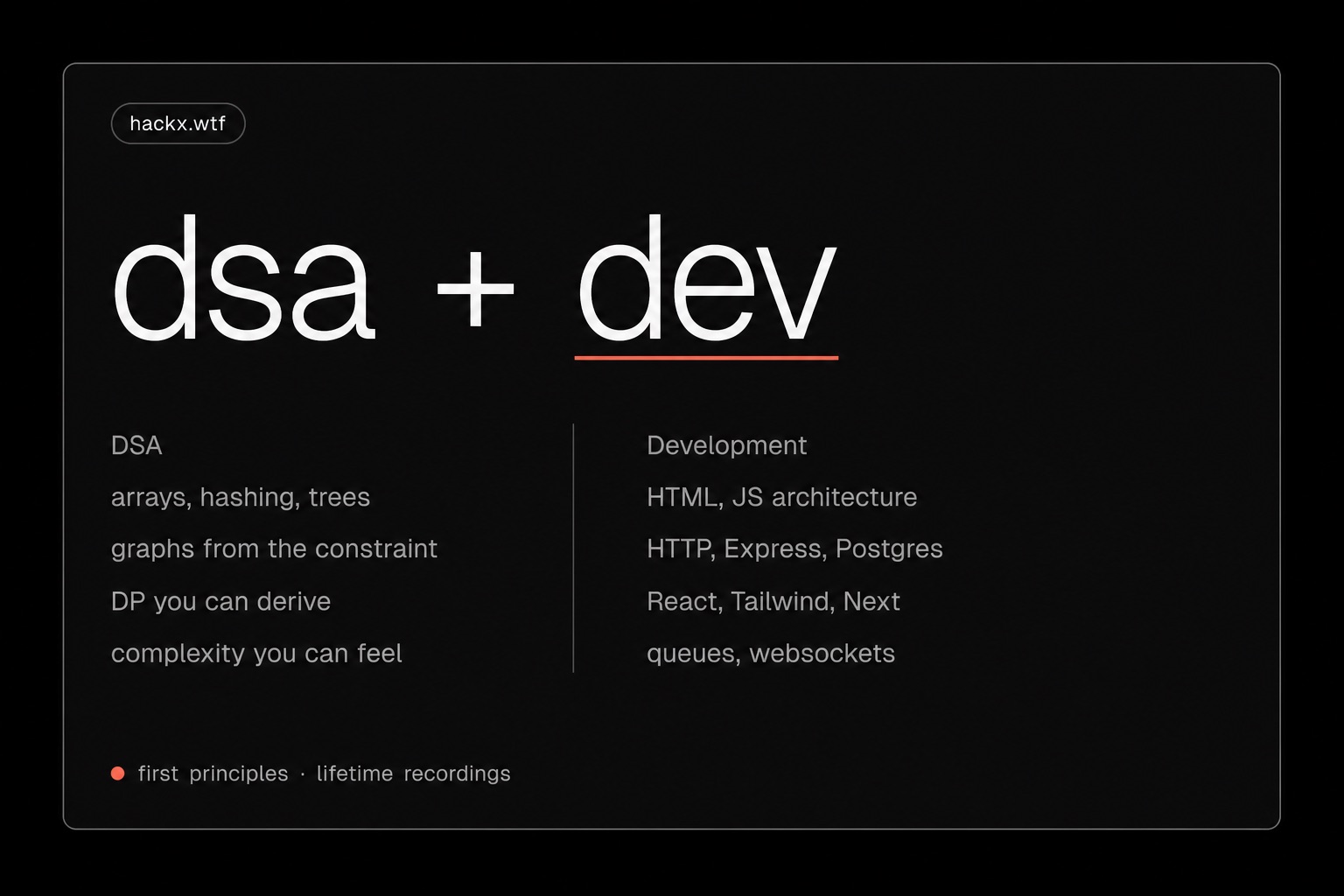
dsa · development
- Tinglish
dsa + dev
for when you need to build it and explain the structure.
₹1₹599
- dsa from real problems, not named patterns
- how the web actually works, then you build with it
- lifetime access to the recordings
Two tracks. Learn what you will be building in real companies, in our own mother tongue.
తెలుగుEnglish·one class, Tinglish
01
Problem first
Sit with it, then write the code.
02
Lifetime
Access on the email you pay with.
03
Tinglish
Telugu and English in one class.
04
Two courses
dsa + dev, and ai/ml + dsa.
First 10 get 100% off with HACK. Lifetime access on the email you pay with.
dsa · development
for when you need to build it and explain the structure.
₹1₹599
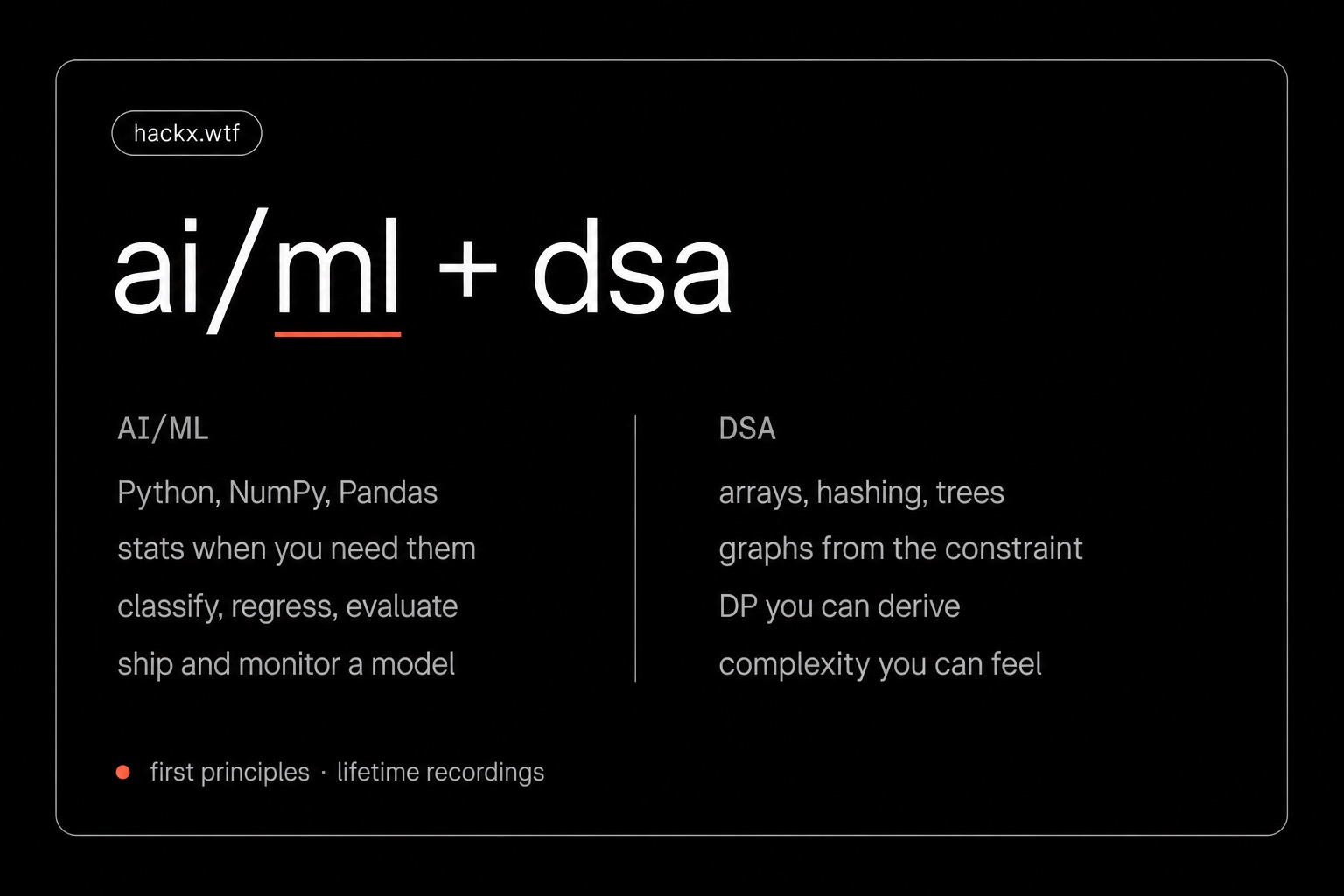
ai/ml · dsa
ml you can feel first. math when you actually need it.
₹1₹699
about
We teach the best of DSA, development, and ai/ml — what actually needs to be taught. Learn the stuff you actually need to, the way you'll have to use it.
01
The best of dsa, development, and ai/ml — what actually needs to be taught. Judgment that shows up in interviews and in real systems, not another 80-hour playlist.
02
You get a problem. You struggle, derive the approach, then write the code. Same loop for dsa, for development, and for ai/ml.
03
Lifetime recordings on the email you pay with. Two courses at launch. Rewatch until the idea sticks — not until a timer runs out.
how you learn
Every lesson starts with a problem you might actually hit. You sit with it, take it apart, then write the code.
01
No recipe on the slide. You get a real constraint, sit with it, and wait until the structure is obvious.
# a real constraint. no name yet.given = what_breaks()# sit until the shape shows
02
If people usually cram it, you build a tiny version first. Then you see where that same idea shows up when it actually has to work.
# smallest cut that still countspart = cut(given)# then where it has to work
03
You only add theory when it earns its place. The code comes after you can explain why it has to look like that.
# write it when you can explain itreturn make(part)# theory only if it earned it
instructor
Built by engineers who have worked across large-scale distributed systems, machine learning pipelines, and production codebases.
Enroll when you're ready, or read how a lesson actually runs.
dsa + dev or ai/ml + dsa. Same email you pay with. Lifetime recordings.
Problem, then the cut, then the code. No 80-hour playlist. No named pattern on the slide.
No. You work a real problem, struggle with the intuition, derive the approach, then write the code. You're here to get that loop, not to collect hours watched.
The course page has the live syllabus — topics, projects, and resources. Recordings follow that map, and we update it as lessons ship.
100% off if you're in the first 10 students. After that, launch price. Checkout always uses the live amount, so if a coupon closes or a price changes mid-pay, you go back to the new price.
You should be comfortable writing basic code. We won't start from what a variable is. We will start from problems worth thinking about.
English and Telugu. Tinglish (Telugu + English) — we switch when it makes the idea land, not as a performance.
Building products and implementation interviews: dsa + dev. Going into ml systems with the same habit: ai/ml + dsa. Both share the dsa spine.
Use the email you actually check. We send access there. Keep the payment id from the success page if something's missing.
Two tracks. Learn what you will be building in real companies, in our own mother tongue.
తెలుగుEnglish·one class, Tinglish
01
Problem first
Sit with it, then write the code.
02
Lifetime
Access on the email you pay with.
03
Tinglish
Telugu and English in one class.
04
Two courses
dsa + dev, and ai/ml + dsa.
First 10 get 100% off with HACK. Lifetime access on the email you pay with.
dsa · development
for when you need to build it and explain the structure.
₹1₹599
ai/ml · dsa
ml you can feel first. math when you actually need it.
₹1₹699
about
We teach the best of DSA, development, and ai/ml — what actually needs to be taught. Learn the stuff you actually need to, the way you'll have to use it.
01
The best of dsa, development, and ai/ml — what actually needs to be taught. Judgment that shows up in interviews and in real systems, not another 80-hour playlist.
02
You get a problem. You struggle, derive the approach, then write the code. Same loop for dsa, for development, and for ai/ml.
03
Lifetime recordings on the email you pay with. Two courses at launch. Rewatch until the idea sticks — not until a timer runs out.
how you learn
Every lesson starts with a problem you might actually hit. You sit with it, take it apart, then write the code.
01
No recipe on the slide. You get a real constraint, sit with it, and wait until the structure is obvious.
# a real constraint. no name yet.given = what_breaks()# sit until the shape shows
02
If people usually cram it, you build a tiny version first. Then you see where that same idea shows up when it actually has to work.
# smallest cut that still countspart = cut(given)# then where it has to work
03
You only add theory when it earns its place. The code comes after you can explain why it has to look like that.
# write it when you can explain itreturn make(part)# theory only if it earned it
instructor
Built by engineers who have worked across large-scale distributed systems, machine learning pipelines, and production codebases.
Enroll when you're ready, or read how a lesson actually runs.
dsa + dev or ai/ml + dsa. Same email you pay with. Lifetime recordings.
Problem, then the cut, then the code. No 80-hour playlist. No named pattern on the slide.
No. You work a real problem, struggle with the intuition, derive the approach, then write the code. You're here to get that loop, not to collect hours watched.
The course page has the live syllabus — topics, projects, and resources. Recordings follow that map, and we update it as lessons ship.
100% off if you're in the first 10 students. After that, launch price. Checkout always uses the live amount, so if a coupon closes or a price changes mid-pay, you go back to the new price.
You should be comfortable writing basic code. We won't start from what a variable is. We will start from problems worth thinking about.
English and Telugu. Tinglish (Telugu + English) — we switch when it makes the idea land, not as a performance.
Building products and implementation interviews: dsa + dev. Going into ml systems with the same habit: ai/ml + dsa. Both share the dsa spine.
Use the email you actually check. We send access there. Keep the payment id from the success page if something's missing.